
Decoding Transcriptomes: A Practical Course on RNA-seq 2027
15th – 19th March 2027
Overview
This hands-on program provides a comprehensive introduction to RNA sequencing, guiding participants through the complete workflow from sample preparation to data analysis. Participants will gain practical experience in RNA quality control, mRNA library preparation for Next Generation Sequencing (NGS), and library quality control. On the computational side, they will work with real sequencing data to learn key steps including data quality assessment, alignment, quantification, differential expression analysis, and functional interpretation.
The course integrates laboratory practice with computational training, equipping participants with the skills needed to design robust RNA-seq experiments and to apply reproducible analysis workflows following the FAIR practices. The program is complemented by theoretical lectures on state-of-the-art transcriptomics and bioinformatics, a guided visit to the CRG Genomics Unit, and networking activities.

Target Audience
Researchers, laboratory technicians, and bioinformaticians are interested in RNA-seq using next-generation sequencing (NGS), covering the complete workflow from sample preparation to data analysis.
Format
A hybrid program combining concise theoretical sessions with hands-on laboratory work (RNA QC, library preparation, sequencing) and practical computational analysis using reproducible workflows.
Main Goals
Participants will:
- Get an overview of the state-of-the-art in Transcriptomics and Next Generation Sequencing (NGS)
- Understand the differences between bulk RNA-seq, single-cell sequencing, and spatial transcriptomics
- Design RNA-seq experiments for diverse applications
- Perform RNA and library quality control and prepare mRNA libraries
- Understand NGS platforms and sequencing workflows.
- Assess RNA-seq data quality and work with common file formats.
- Perform reproducible RNA-seq data analysis, from quality control to differential expression.
- Conduct functional interpretation of RNA-seq results, including gene set enrichment analysis.
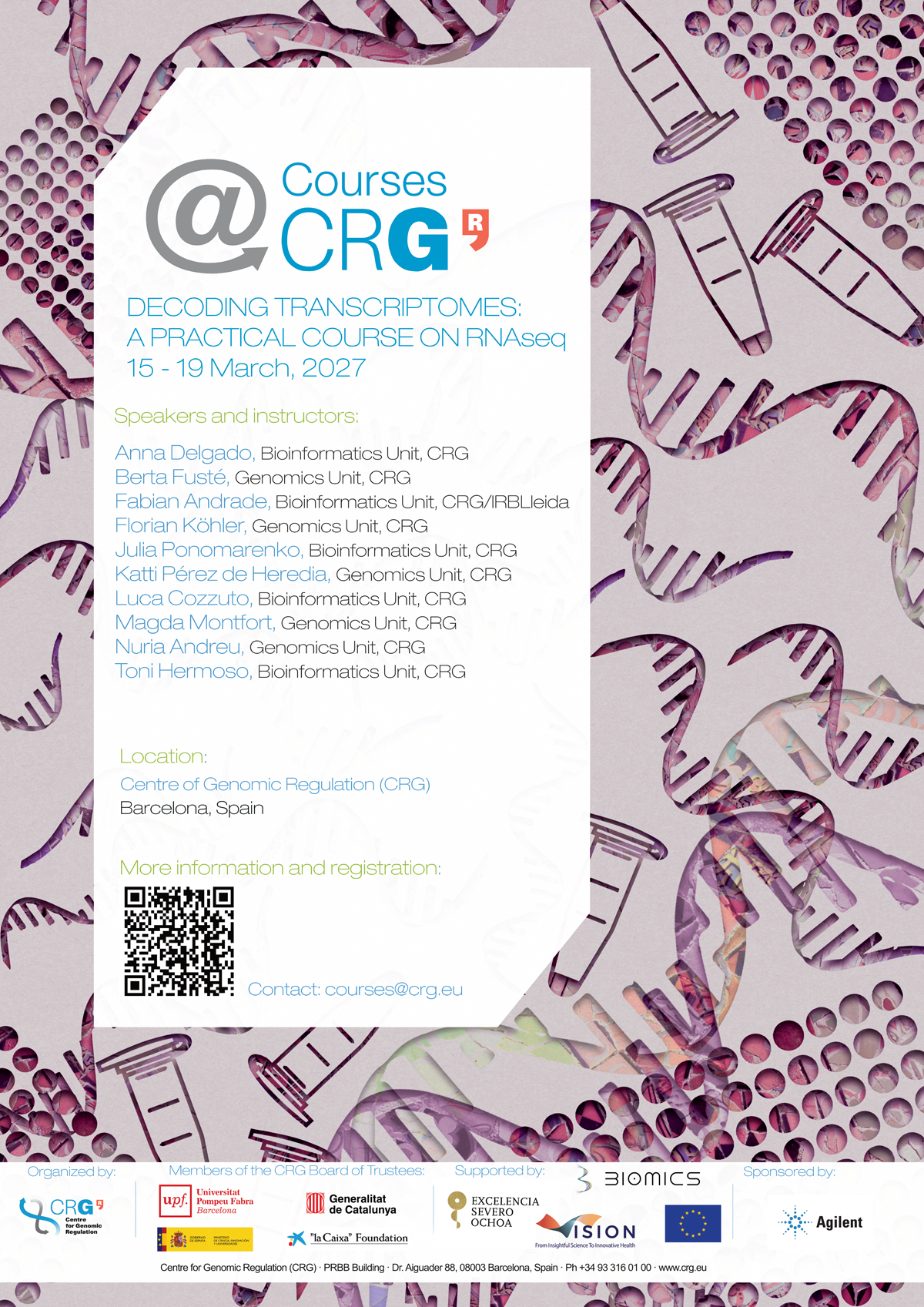
Scientific Organisers
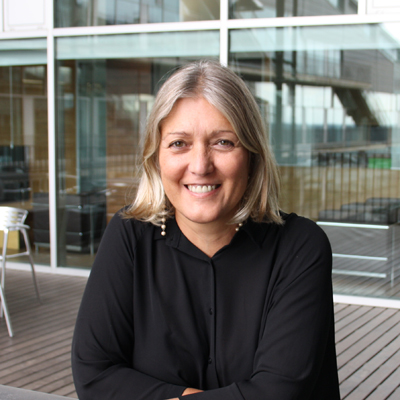


Genomics Unit
The Genomics Unit at the Center for Genomic Regulation (CRG) is part of the institute’s Core Technologies Program. It provides state-of-the-art next-generation sequencing (NGS) services to both internal researchers and external collaborators from academia and industry. The Unit offers a broad range of standard and customized protocols for DNA and RNA sequencing, with a strong focus on developing innovative methodologies and implementing cutting-edge technologies. Its activities support diverse research areas, including biomedicine, biodiversity, comparative genomics, ecosystem monitoring, and agrigenomics. More details can be found on the Genomics Unit website.
Bionformatics Unit
The Bioinformatics Unit supports researchers at CRG, PRBB, and beyond with high-throughput sequencing data analysis, experimental planning, and bioinformatics solutions that foster reproducible research, as well as provides training to disseminate good practices.
Training & Academic Office (TAO)
The CRG Training & Academic Office works closely with scientific organisers and Core Technologies to develop, coordinate and deliver high-quality scientific training programmes.
Through Courses@CRG, TAO contributes to the planning and development of training activities, participant engagement, and the overall learning experience, helping ensure that courses meet the needs of the international research community.
Speakers & Instructors






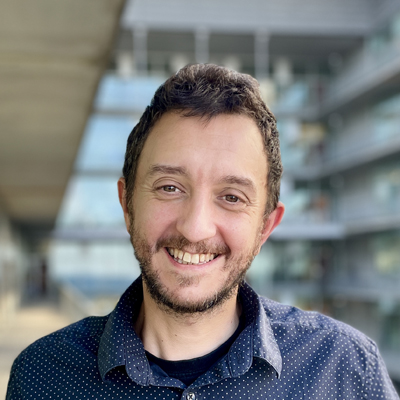
Programme
Day 1 – Monday 15 March 2027
Nuria Andreu, Magda Montfort and Katti Pérez de Heredia
|
9:15-9:30 |
Registration |
|
9:30-10:30 |
Welcome and course overview |
|
10:30-11:30 |
Talk 1: Introduction to Next Generation Sequencing (NGS) and applications Berta Fusté |
|
11:30-12:00 |
- Coffee break -
|
|
12:00-13:00 |
Talk 2: Transcriptomics - from bulk to single-cell and spatial Florian Köhler |
|
13:00-14:00 |
- Lunch -
|
|
14:00-14:30 |
Talk 3: Quality control of RNA samples Nuria Andreu |
|
14:30-15:00 |
Talk 4: Introduction to the mRNA library preparation protocol Nuria Andreu |
|
15:00-17:00 |
Hands-on: Prepare mRNA beads Nuria Andreu, Magda Montfort and Katti Pérez de Heredia |
|
17:00-18:00 |
Visit to the Genomics Core Facility |
Day 2 – Tuesday 16 March 2027
|
9:00-13:00 |
Hands-on: First part of the mRNA library preparation |
|
13:00-14:00 |
- Lunch -
|
|
14:00-16:00 |
Hands-on: Second part of the mRNA library preparation Nuria Andreu, Magda Montfort and Katti Pérez de Heredia |
|
16:00-18:00 |
Hands-on: Library quality control Nuria Andreu, Magda Montfort and Katti Pérez de Heredia |
Day 3 – Wednesday 17 March 2027
|
9:00-10:30 |
Hands-on: Library quality control Nuria Andreu, Magda Montfort and Katti Pérez de Heredia |
|
10:30-11:00 |
- Coffee break -
|
|
11:00-11:30 |
Talk 5: Pre-processing of raw data and FASTQ format - what happens to data after libraries are sequenced Anna Delgado |
|
11:45-12:15 |
Talk 6: FAIR and reproducible practices in bioinformatics - containers, public repositories, Git/GitHub Toni Hermoso |
|
12:15-13:00 |
Talk 7: RNA-seq data analysis - workflow and approaches Luca Cozzuto |
|
13:00-14:00 |
- Lunch -
|
|
14:00-15:30 |
Hands-on: Read QC - FastQC, FastqScreen, Kraken, MultiQC Anna Delgado |
|
15:30-16:15 |
Hands-on: Read pre-processing - adapter trimming, riboPicker, MultiQC Luca Cozzuto |
|
16:15-16:30 |
- Coffee break -
|
|
16:30-18:30 |
Hands-on: Reference genome/transcriptome and annotation (Ensembl, GENCODE, UCSC Genome Browser); GTF/GFF format Luca Cozzuto |
Day 4 – Thursday 18 March 2027
|
9:00-11:00 |
Hands-on: Read mapping to the reference genome/transcriptome and quantification (STAR, Salmon, SAM/BAM format, samtools, gene/transcript quantification, QualiMap) Luca Cozzuto |
|
11:00-11:30 |
- Coffee break -
|
|
11:30-13:00 |
Hands-on: DESeq2 - importing data from STAR and Salmon, filtering and normalization, PCA, sample clustering Fabian Andrade, Julia Ponomarenko |
|
13:00-14:00 |
- Lunch -
|
|
14:00-16:00 |
Hands-on: Differential expression analysis using DESeq2 Fabian Andrade, Julia Ponomarenko |
|
16:00-16:15 |
- Coffee break -
|
|
16:15-18:30 |
Hands-on: Functional analysis Fabian Andrade, Julia Ponomarenko |
Day 5 – Friday 19 March 2027
|
9:00-11:00 |
Hands-on: Running the full analysis using the nf-core pipeline Luca Cozzuto |
|
11:00-11:30 |
- Coffee break -
|
|
11:30-12:00 |
Talk 8: Design of RNA-seq experiments and beyond bulk RNA-seq Julia Ponomarenko |
|
12:00-13:00 |
Q&A and general discussion |
|
13:00-14:00 |
- Lunch -
|
Registration
Number of participants: 16
Dates: 16th – 20th March 2026 (5 days)
Registration fee: 500 Euros (+21% VAT) for academic researchers and 1,000 Euros (+21% VAT) for industry participants. The fee covers full participation, course materials, lunches, coffee breaks, and social events. Travel and accommodation are not included.
Registration deadline: 15th December 2026
Before you register
Registration includes a 30–45 minute Linux and R skills assessment. Please prepare your computer and download the required files before starting.
Required skills Linux & R
The assessment will cover only the topics listed below. You should be able to understand, execute, and make simple modifications to commands and R code, but you are not expected to write complete scripts or perform bioinformatics analyses.
1. Linux command line
You should be able to:
- Navigate the filesystem: use pwd, ls, and cd; understand absolute and relative paths, including . and ..
- Manage files and directories: use mkdir, cp, mv, and rm.
- View text files: use cat, head, tail, and less.
- Inspect compressed files: use zcat to view the contents of .gz files without decompressing them.
- Edit text files: use nano or another simple text editor to open, modify, save, and close files.
- Search and manipulate text: use grep, cut, and sort to search for patterns, extract columns, and sort lines.
- Use pipes and redirection: understand |, >, and >> to combine commands and save output.
- Use wildcards: understand * for matching filenames.
- Understand command syntax: recognize commands, options, arguments, and file paths; execute and modify provided commands.
- Recognize common errors: identify problems such as missing files, incorrect paths, or unrecognized commands.
You do not need to learn shell scripting, loops, awk, sed, or advanced Linux administration.
2. R and RStudio
You should be able to:
- Use RStudio: navigate the console, script editor, environment, and plots; execute supplied R code.
- Understand basic R syntax: variables, assignment (<-), numbers, strings, logical values, and comments.
- Work with basic data structures: vectors, matrices, and data frames; understand rows, columns, and dimensions.
- Access and subset data: use [ ], $, and column names to select values, rows, and columns.
- Import data: read CSV and tab-delimited files using supplied commands.
- Inspect and summarize data: use head(), dim(), str(), summary(), mean(), and sum().
- Understand functions: recognize function calls, arguments, and returned values; modify simple arguments in supplied code.
- Work with packages: understand library() and the difference between installing and loading a package.
- Understand basic plots: recognize scatter plots, boxplots, and histograms and interpret their axes.
You do not need to learn programming loops, writing functions, advanced statistics, ggplot2, tidyverse, or Bioconductor before the course.
Assessment instructions 30–45 min
The course requires basic Linux command-line and R skills. As part of registration, you will complete a short assessment to help us select a group with similar skill levels and adapt the course accordingly. We encourage you to prepare using the recommended learning resources before registering. Please complete the assessment independently, without asking the Internet, AI tools, or external help. We value an accurate picture of your skills more than a high score.
The registration form includes a Linux and R skills assessment, which takes approximately 30–45 minutes to complete.
Before starting, please make sure that:
- You have a terminal available on your computer (Linux, macOS, or Windows with WSL) and can execute basic Linux commands.
- You have R and RStudio installed and ready to use.
- You have downloaded both assessment files (see Download assessment files).
- You have a stable Internet connection and enough uninterrupted time to complete the form.
Important: The registration form may not save your progress. If your connection is interrupted or you close the page, you may lose your answers and need to start again. We recommend reviewing the required skills and completing the suggested preparatory tutorials before opening the registration form.
Download assessment files 2 files
Before starting registration, download both files using your terminal:
Linux assessment (FASTA file):
wget https://github.com/biocorecrg/RNAseq_coursesCRG_2026/raw/refs/heads/master/assessment/linux_assessment.fasta
or
curl -L -O https://github.com/biocorecrg/RNAseq_coursesCRG_2026/raw/refs/heads/master/assessment/linux_assessment.fasta
R assessment (data file):
wget https://github.com/biocorecrg/RNAseq_coursesCRG_2026/raw/refs/heads/master/assessment/r_assessment.csv
or
curl -L -O https://github.com/biocorecrg/RNAseq_coursesCRG_2026/raw/refs/heads/master/assessment/r_assessment.csv
Recommended tutorials Free online
If you are not yet familiar with all the required Linux and R skills, we recommend the following free online tutorials to help you prepare before registration.
Linux command line
Software Carpentry — The Unix Shell
Recommended lessons:
- Navigating Files and Directories
- Working With Files and Directories
- Pipes and Filters
- Finding Things
R and RStudio
Software Carpentry — R for Reproducible Scientific Analysis
Recommended lessons:
Complete Your Registration
Please complete both steps to submit your application.
STEP 1 · Registration & Level Test
Fill in your details and complete the level test.
STEP 2 · CV Submission
Upload your CV to complete your application.
Sponsors

Supported by


CRG Trustees
.png)


Distinction

Contact and venue
CRG Training and Academic Office
Email: courses@crg.eu
Phone: +34933160375
CRG – Centre for Genomic Regulation
Dr. Aiguader, 88
08003 Barcelona, Spain
Transport
By plane:
By train:
The city's main station is Estació de Sants. This station is serviced by numerous national and international trains, including high-speed trains.
Barcelona has other train stations:
- Estació de França, near Parc de la Ciutadella
- Plaça de Catalunya, in the city centre.
- Clot-Aragó, near Plaça de les Glòries.
- Arc de Triomf, station has a connection with Barcelona Nord bus station.
- Passeig de Gràcia, at the heart of the Modernista route.
Long-distance journeys are best booked in advance but for shorter journeys, including those in Barcelona on the local Rodalies (Catalan) or Cercanías (Spanish) services, you can buy a ticket before boarding the train.
Barcelona is also served by the Ferrocarrils de la Generalitat de Catalunya (FGC). Although they run short and medium-distance inter-city train services, these are integrated into the city's underground network, the Metro, which means you can use the T-10, a combined ticket for 10 journeys on city buses and the underground as well as the FGC trains.
By bus:
The main bus station is Barcelona Nord, which is very near the center, by the Arc de Triomf, although most buses stop at Sants station. There are national and international services and usually, it is not necessary to book in advance. The bus station is linked to the city’s underground system. Look at the map with the different underground lines and bus routes on the TMB website.
Transport from the Barcelona Airport El Prat
You can get to the city from the airport with the Aerobús with stops in Plaça d’Espanya, Urgell, Plaça de la Universitat and Plaça de Catalunya, or the underground line L9. The airport train station is located 200 meters outside the terminal T2 building and the train goes to the Barcelona Sants Estació.
There is also a standard bus and night bus. Click here for more information.
