
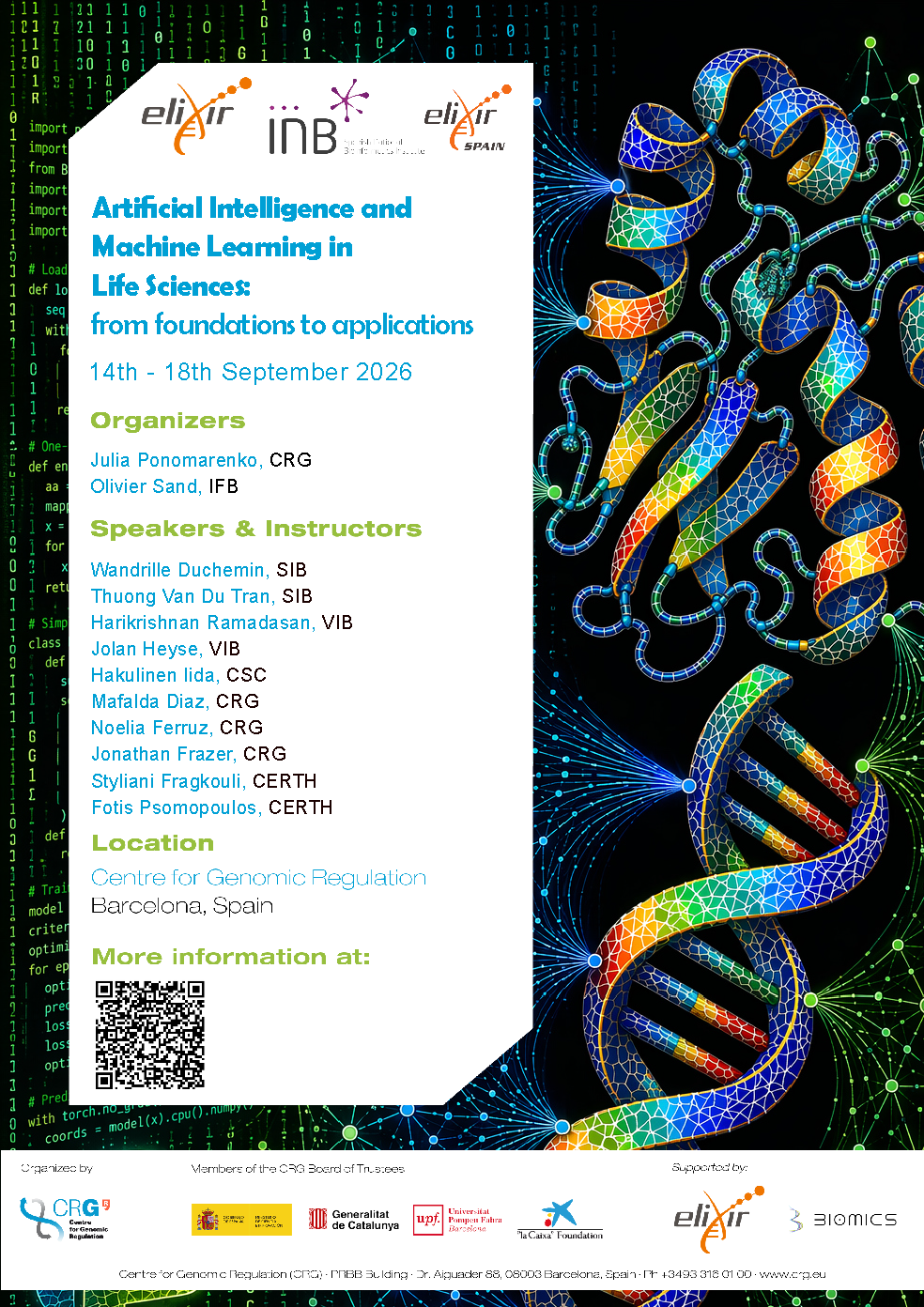
Artificial Intelligence and Machine Learning in Life Science: from foundations to applications (2026)
14th – 18th September 2026
Overview
“ELIXIR course: Artificial Intelligence and Machine Learning in Life Sciences” provides researchers with the conceptual foundations and practical skills needed tu use AI and ML methods appropriately, critically, and reproducibly in life-science research. If you plan to analyse complex biological datasets or incorporate AI-based approaches into your work, this course may be for you.
Artificial Intelligence (AI) and Machine Learning (ML) are rapidly transforming life sciences, enabling new approaches to the analysis, interpretation, and integration of increasingly large and complex biological datasets. To fully benefit from these advances, researchers need both a solid understanding of AI/ML methods and awareness of their limitations, best practices, and regulatory frameworks.
This five-day, hands-on training course will guide participants from the foundations of machine learning through deep learning, foundation models, and generative AI, while also covering reproducibility, the DOME recommendations, and the EU AI Act.
Building on the success of the first edition, this second ELIXIR Summer School on Artificial Intelligence and Machine Learning in Life Sciences will bring together AI/ML experts from five ELIXIR Nodes and 25 participants from across the ELIXIR community, fostering knowledge exchange, collaboration, and the responsible adoption of AI in life sciences.
Main Goals
At the end of the course, the participants should be able to:
- Apply the general machine learning data analysis pipeline to tabular data.
- Implement and train deep neural networks to solve tasks such as image and sequence classification.
- Use unsupervised approaches to analyse genomics datasets.
- Evaluate probabilistic modelling approaches for their own data and research questions.
- Describe techniques for fine-tuning pre-trained large language models.
Target audience
This course is addressed to bioinformaticians, biostatisticians, bioanalysts, life scientists and biomedical researchers with solid Python programming skills and general knowledge of machine learning (please see the prerequisites below).
Prerequisites
Knowledge / competencies
The level of this course is intermediate, with the following requirements:
- Intermediate Python programming
- Experience with data analysis and statistical reasoning
- Experience with Jupyter Notebooks is desirable
- Some prior knowledge of machine learning is a plus
During the registration process you will be asked to take a short quiz to assess your level and to help us get to know you better.
Participants in the course are required to abide by the ELIXIR Code of Conduct. Please make sure that (if accepted) you read it before the event.
Materials
Participants are required to bring their own laptop.
During the course, we will use online Jupyter Notebooks platforms (e.g. Kaggle Notebooks), particularly for access to GPUs.
Instructions for setting up the course environment on a local machine will also be provided. However, support for troubleshooting local installations will be limited.
Scientific Organisers


Instructors












Programme
Day 1 – Monday 14 September 2026
|
Introduction to Machine Learning Instructors: Wandrille Duchemin & Thuong Van Du Tran |
|
| 13:30-14:00 |
Registration |
|
14:00-15:00 |
Welcome and participant introduction |
|
15:00-16:00 |
Introduction to Machine Learning: the motivation to go beyond simple models |
| 16:00-16:30 |
Deploying a machine learning pipeline with scikit-learn |
|
16:30-16:45 |
- Coffee break - |
|
16:45-18:15 |
Logistics regression: classification metrics, class imbalance and common pitfalls |
| 18:15-19:15 |
Decision trees: a different model but similar strategies |
| 19:30-21:30 |
- Social Activity & Dinner - |
Day 2 – Tuesday 15 September 2026
|
Deep Learning Foundations Instructors: Harikrishnan Ramadasan & Jolan Heyse |
|
|
09:00-09:15 |
Introduction to neural networks |
|
09:15-10:15 |
From logistic regression to neural networks: neurons, layers, activations and backpropagation |
| 10:15-11:00 |
Building and training neural networks with PyTorch |
|
11:00-11:15 |
- Coffee break - |
|
11:15-12:00 |
Optimization and regularization: gradient descent, learning rates, dropout and batch normalization |
| 12:00-13:00 |
Practical session: training and evaluating neural networks |
|
13:00-14:00 |
- Lunch - |
|
14:00-15:15 |
Convolutional neural networks: principles and applications to biological data |
| 15:15-16:00 |
Sequence modelling: from recurrent neural networks to attention |
|
16:00-16:15 |
- Coffee break - |
| 16:15-17:30 |
Transformers: architecture, embeddings and foundation models |
| 17:30-19:00 |
Practical session: exploring transformer models for biological sequences and omics data |
Day 3 – Wednesday 16 September 2026
|
Generative AI for Biological Data Instructors: Mafalda Dias, Noelia Ferruz & Jonathan Frazer |
|
|
09:00-09:55 |
Probabilistic modelling (a Bayesian perspective): Bayesian models as generative stories, encoding prior knowledge, biological inductive bias, notes on inference (VI and ELBO) |
|
09:55-10:50 |
Hands-on session: probabilistic modelling |
|
10:50-11:05 |
- Coffee break - |
|
11:05-12:00 |
Latent Variable Models: Hierarchical models, VAEs, diffusion models |
|
12:00-13:00 |
Hands-on session: Hierarchical models and VAEs of genetic variation |
|
13:00-14:00 |
- Lunch - |
|
Generative protein models & Explainable AI (XAI) |
|
|
14:00-14:30 |
Generative AI in protein design |
| 14:30-15:00 |
Protein language models in protein design |
| 15:00-16:00 |
Steering models: Fine-tuning and reinforcement learning |
| 16:00-16:15 |
- Coffee break - |
| 16:15-16:45 |
XAI for protein language models |
| 16:45-18:00 |
Hands-on |
| 19:00-21:00 |
- Tapas Dinner - |
Day 4 – Thursday 17 September 2026
|
AI regulations and Group projects Instructors: Styliani-Christina Fragkouli & Fotis Psomopoulos |
|
|
09:00-11:00 |
AI ethics, regulations, FAIR standards, reproducibility |
|
11:00-11:15 |
- Coffee break - |
|
11:15-13:00 |
Start group projects |
| 13:00-14:00 |
- Lunch - |
| 14:00-16:00 |
Group projects (continuation) |
| 16:00-16:15 |
- Coffee break - |
| 16:15-18:00 |
Group projects (continuation) |
Day 5 – Friday 18 September 2026
|
Group projects, discussion and closure |
|
|
09:00-11:00 |
Group projects (continuation) |
|
11:00-11:15 |
- Coffee break - |
|
11:15-12:30 |
Group project presentations |
| 12:30-13:00 |
Discussion with Q&A |
|
13:00-14:00 |
- Lunch & Farewell - |
Registration
Number of participants: 25
Dates: 14th – 18th September 2026
Registration fee: 300€ (+21% VAT) for academic researchers or 600€ (+21% VAT) for industry. It includes participation in the workshop, teaching materials, coffee breaks, lunches, and a social activity with dinner on Day 1 and tapas dinner on Day 3. Accommodation, travel, and additional dinners are not included.
Registration deadline EXTENDED: 10th July 20th July 2026 We are no longer accepting applications!
Missed the deadline? Inform me about the next edition of Courses@CRG
Courses@CRG brings international experts in a specialized field to teach at the CRG, attracting professionals from all over the world. Each course programme includes theoretical lectures and hands-on sessions, enabling participants to acquire new skills and/or knowledge, either specific to a field or interdisciplinary in nature.
Selection criteria: Applications will be evaluated based on prerequisite skills and knowledge, as well as motivation for the training. Selected participants will be notified via email by August 2026.
Sponsors


Contact and venue
Contact
CRG Training and Academic Office
Email: tao@crg.eu
Phone: +34933160375

Venue
CRG – Centre for Genomic Regulation
Dr. Aiguader, 88
08003 Barcelona, Spain
Arrival at Barcelona
By plane:
-
Barcelona’s main airport is Josep Tarradellas Barcelona-El Prat
-
Girona Airport (90 km)
-
Reus Airport (105 km)
By train:
The city's main station is Estació de Sants. This station is serviced by numerous national and international trains, including high-speed trains.
Barcelona has other train stations:
- Estació de França, near Parc de la Ciutadella
- Plaça de Catalunya, in the city centre.
- Clot-Aragó, near Plaça de les Glòries.
- Arc de Triomf, station has a connection with Barcelona Nord bus station.
- Passeig de Gràcia, at the heart of the Modernista route.
Long-distance journeys are best booked in advance but for shorter journeys, including those in Barcelona on the local Rodalies (Catalan) or Cercanías (Spanish) services, you can buy a ticket before boarding the train.
Barcelona is also served by the Ferrocarrils de la Generalitat de Catalunya (FGC). Although they run short and medium-distance inter-city train services, these are integrated into the city's underground network, the Metro, which means you can use the T-10, a combined ticket for 10 journeys on city buses and the underground as well as the FGC trains.
By bus:
The main bus station is Barcelona Nord, which is very near the center, by the Arc de Triomf, although most buses stop at Sants station. There are national and international services and usually, it is not necessary to book in advance. The bus station is linked to the city’s underground system. Look at the map with the different underground lines and bus routes on the TMB website.
Transport from the Barcelona Airport El Prat
You can get to the city from the airport with the Aerobús with stops in Plaça d’Espanya, Urgell, Plaça de la Universitat and Plaça de Catalunya, or the underground line L9. The airport train station is located 200 meters outside the terminal T2 building and the train goes to the Barcelona Sants Estació.
There is also a standard bus and night bus. Click here for more information.
Supported by




CRG Trustees
.png)


Distinction

